Last updated October 31, 2026
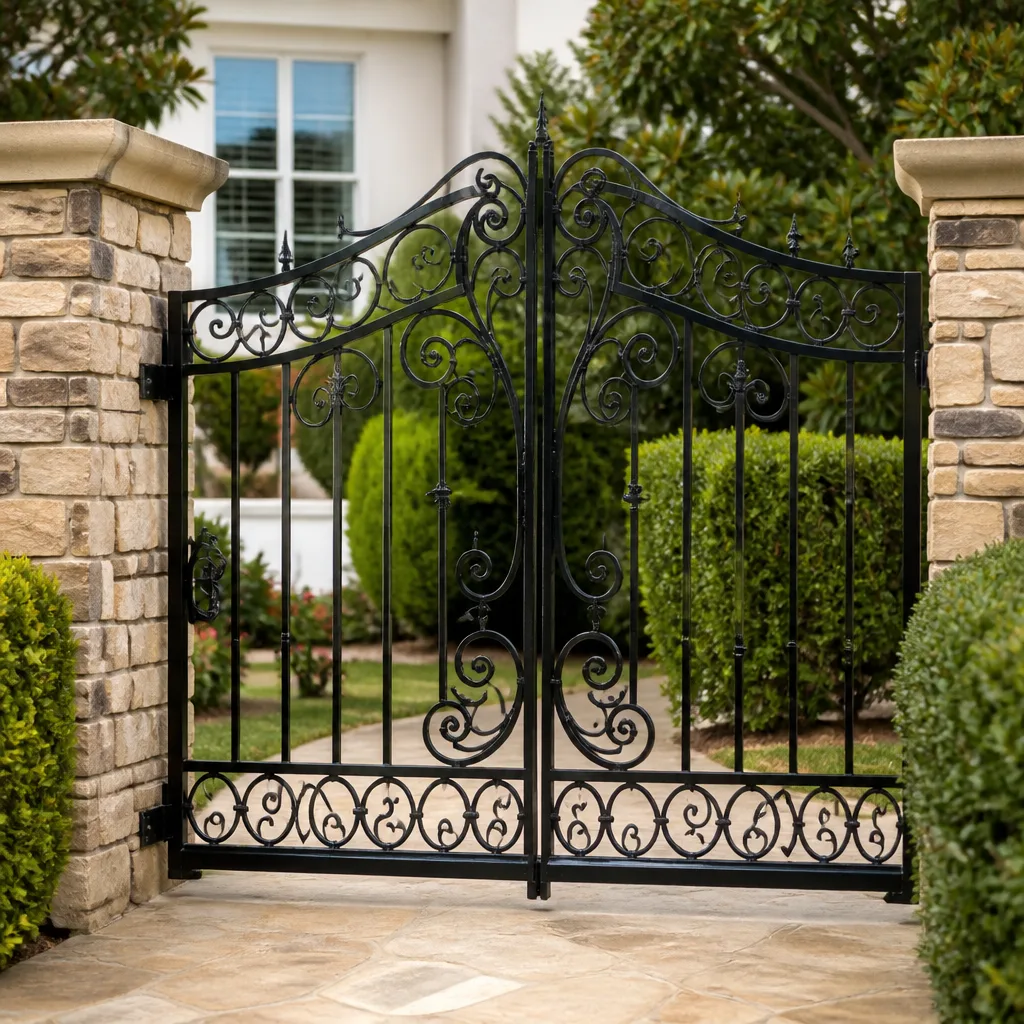 Wrought iron
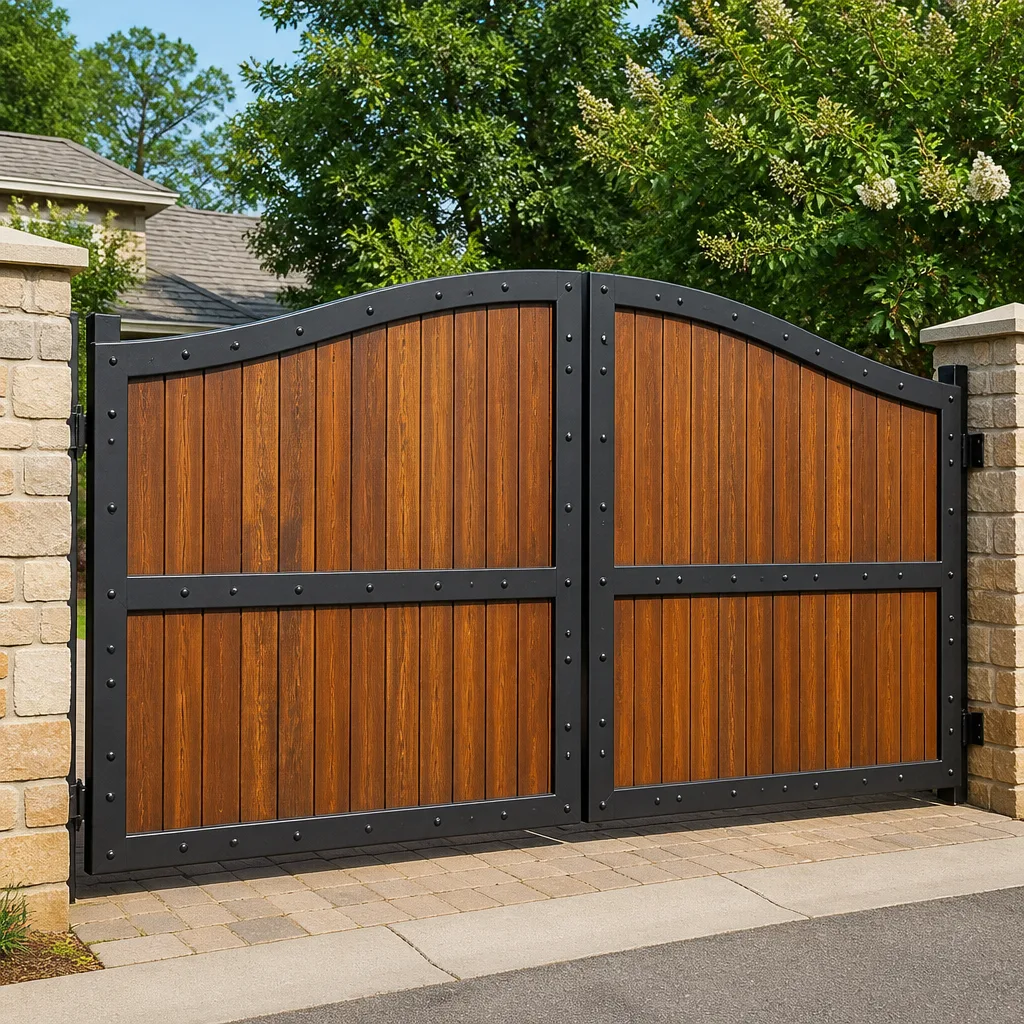 Wood & steel frame
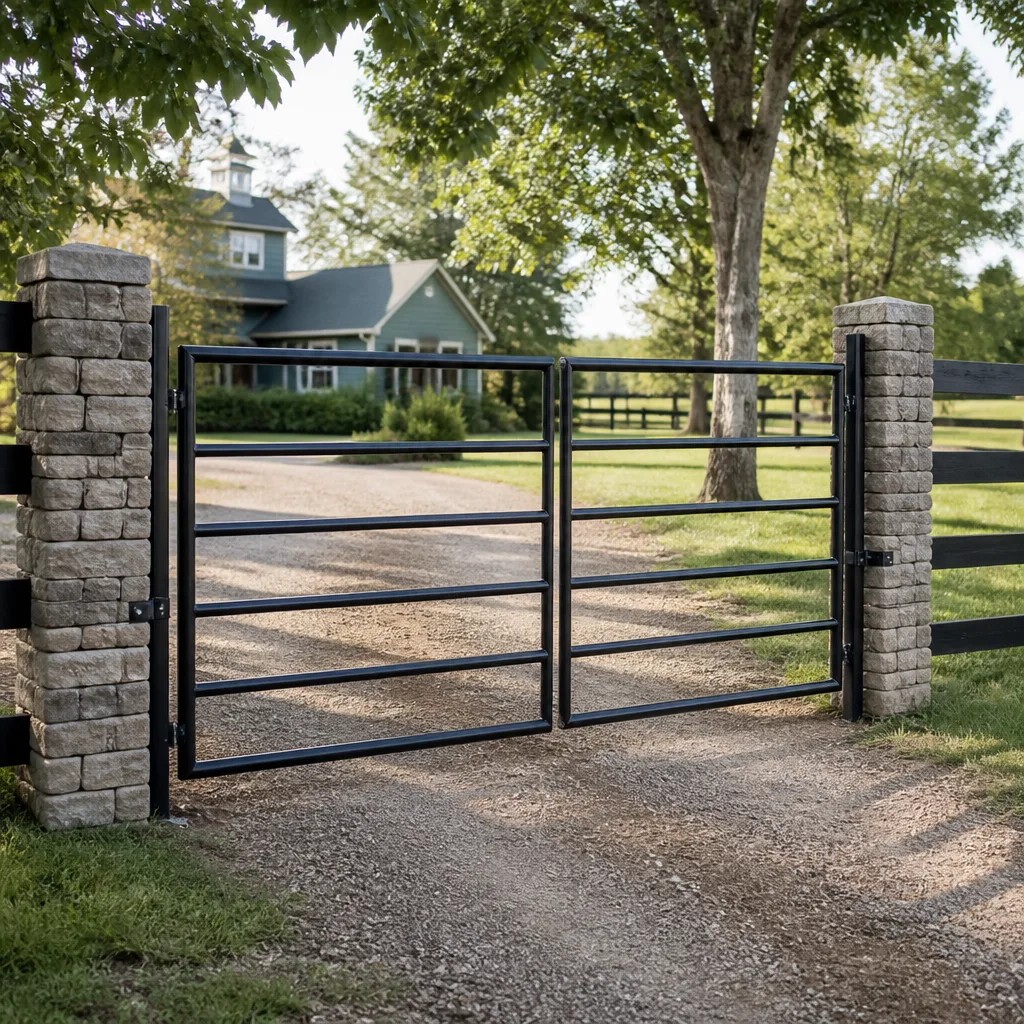 Farm & ranch
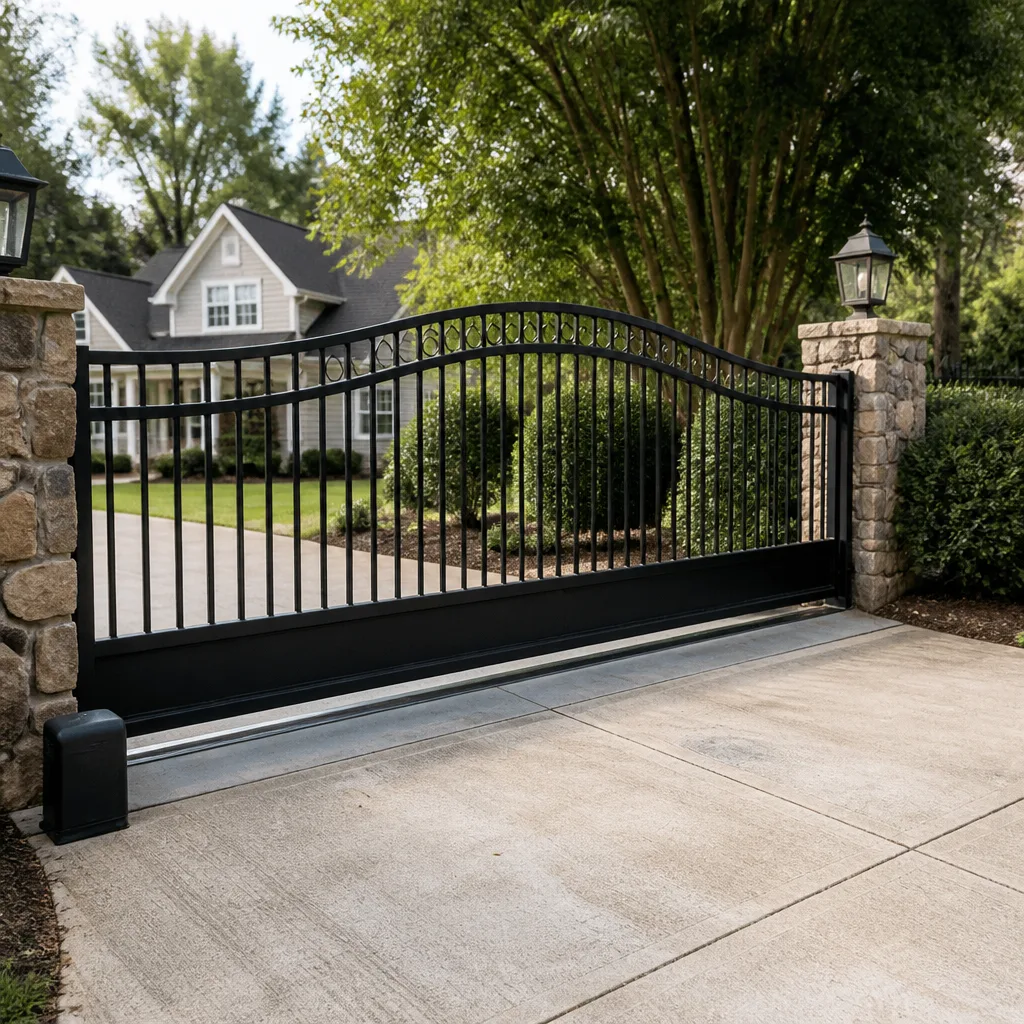 Sliding driveway gates
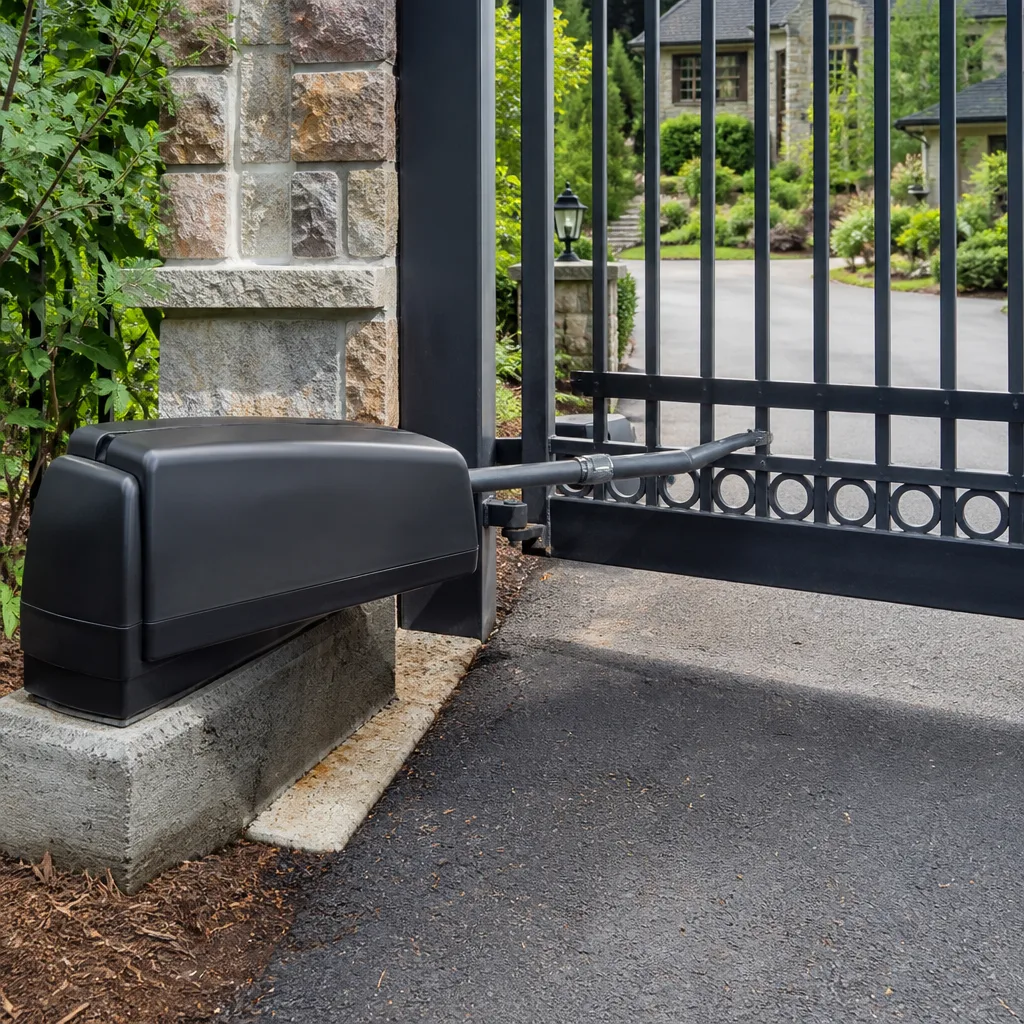 LiftMaster operators
Free on-site gate assessment - hinges, posts, and your LiftMaster or Nice gate operator checked before anything is quoted
The assessment is free and the quote is the invoice.
Get your free estimateHow to Hire a Gate Repair Contractor in Corona: A Step-by-Step Guide
Here’s a counterintuitive fact about the Corona gate repair market: most of the techs who show up at your driveway have never been trained on gate systems at all. They’re garage door installers or general handymen who added “gate repair” to their service list because the tools overlap. The result is a category full of contractors who can replace a hinge but freeze when a control board throws a fault code. In this guide, we’ll walk through exactly how to separate a genuine gate specialist from a generalist in Corona, the interview questions that expose the difference in 30 seconds, how to read a quote like an experienced property manager, and the red flags that predict a bad hire before work even starts. For professional Gate Repair services, always verify specialization first.
Quick Answer
To hire a gate repair contractor in Corona, verify they’re a gate-specific specialist (not a garage door company or general handyman), confirm California licensing and insurance before scheduling, ask brand-specific diagnostic questions during the interview, get a written quote with line-item detail before authorizing work, and confirm the total price before any repair begins. The single best filter: ask the contractor what brands they service. If “FAAC” or “BFT” draws a blank stare, keep looking.
Styles & brands we work with
Table of Contents
- Why the Gate Repair Category Problem Matters in Corona
- Credentials That Actually Matter for Gate Contractors
- Five Interview Questions That Expose a Generalist
- How to Read a Gate Repair Quote: Line Items and Padding
- Corona-Specific Red Flags to Watch For
- How to Verify Insurance and Avoid Liability
- Choosing Between Repair and Replacement
Why the Gate Repair Category Problem Matters in Corona
California’s contractor licensing structure does not have a separate classification for gate specialists. The C-61/D-28 classification covers “doors, gates, and activating devices,” but a general building contractor (Class B) or a handyman working under the $500 per-project threshold can legally offer gate repair in Corona without ever demonstrating gate-specific competency. That’s the structural problem: the state’s licensing system groups gates with garage doors, rolling steel doors, and automatic storefront systems, and a contractor can pass the relevant exam with broad mechanical knowledge but little hands-on gate automation experience.
This matters because gate systems have failure modes that garage door systems don’t. A residential garage door opener has a travel-limit mechanism and a safety reversal sensor. An automated driveway gate adds loop detectors embedded in the concrete, a vehicle detection system, photo-eye sensors calibrated for variable-width openings, and a controller board that manages access protocols. When a generalist misdiagnoses a gate fault, the typical outcome is a part replacement that doesn’t solve the problem, followed by a second service call, followed by a homeowner who has now paid twice for one repair.
We see this pattern regularly in Corona, especially in neighborhoods like Sierra del Oro and Eagle Glen where homeowners have invested in premium gate systems from European manufacturers. A generalist who has spent a career on LiftMaster garage openers looks at a FAAC swing gate operator and starts guessing. The parts are expensive, the control board logic is different, and the diagnosis takes three times longer than it should. That delay isn’t just an inconvenience, it’s a security risk: a gate that won’t close reliably is an open invitation to a property.
This guide exists to give you the tools to avoid that cycle. Our team at Baron Gate Repair home has worked on gate systems across nine major brands, from DIY-grade Mighty Mule openers on ranch gates to commercial Viking operators on access-controlled lots. The advice below is what we’d tell a neighbor before they ever pick up the phone.
Credentials That Actually Matter for Gate Contractors
Start with what you can verify before you even make the first call. In California, any contractor performing gate repair work above $500 in labor and materials must hold a valid contractor’s license from the Contractors State License Board (CSLB). The CSLB website lets you search by business name or license number, and it shows the license classification, expiration date, and any complaints or disciplinary actions on file. Take two minutes to run this search. It’s the highest-value verification you can do, because an expired license or a pattern of complaints tells you everything you need to know before spending another minute on the phone.
Here’s a step-by-step verification process that takes under ten minutes:
- Check the CSLB database. Search for the business name and confirm the license is active, not expired or suspended, and that the classification covers gate work (D-28 or a general B classification with gate experience).
- Confirm the business name matches. If the invoice says “Corona Gate Pros” but the license is registered to a different entity, ask why. Mismatches are a red flag.
- Ask for the insurance certificate directly. The contractor should be able to email you a certificate of liability insurance that names their business and shows general liability coverage. Verify the policy is current by checking the effective dates.
- Confirm workers’ compensation coverage. If the contractor has employees, California law requires workers’ comp. Whether they do or don’t have employees, this is a question worth asking directly, because the answer affects your liability as the homeowner (more on this below).
- Ask about manufacturer training. Gate operator manufacturers like FAAC, BFT, and LiftMaster offer dealer training and certification programs. A contractor who has completed them will usually say so without hesitation. This isn’t a legal requirement, but it’s a strong signal of specialization.
What doesn’t matter: Yelp review count, whether they “have a lot of experience,” and how many years they’ve been in business. Those are all proxy signals for the real question, which is whether this contractor can diagnose the specific gate and operator on your property. Years in business matters less than you’d think. A contractor who has done ten years of garage door work and six months of gate work is less qualified than a gate specialist who has done three years of nothing but gates.
Five Interview Questions That Expose a Generalist
This section contains the single most useful hiring tool in this guide. These questions are designed to be asked over the phone, before you schedule a service call. Each one targets a specific knowledge gap between gate specialists and generalists. A genuine gate technician answers them reflexively. A generalist hesitates, deflects, or gives a vague answer that doesn’t actually address the question.
Question 1: “What’s the difference between a limit switch fault and a torque overload fault on an operator?”
A gate specialist will tell you immediately: a limit switch fault means the operator’s internal switch that tells the motor when to stop at the open or closed position has failed or moved out of alignment, so the motor either doesn’t stop or stops at the wrong point. A torque overload fault means the operator’s safety system detected the motor working harder than its rated capacity, which usually means a physical obstruction, a misaligned hinge, or a failing motor bearing. The specialist can also tell you which one is more common on which brands. If the person on the phone says “uh, they’re pretty similar” or starts talking about “sensor issues” generically, you’re talking to someone who has never actually diagnosed an operator fault.
Question 2: “Which brands of gate operators do you stock parts for?”
Gate specialists don’t stock parts for every brand because no one can, but they know their inventory. A generalist will say “all of them” or “we can order anything.” A specialist will name brands: “We carry control boards and safety edges for LiftMaster and FAAC, and we can typically get BFT or DoorKing parts within a day or two from our local distributor.” The difference is specificity. “All of them” is what someone says when they don’t actually know what parts are in their own truck.
Question 3: “If you arrive and the gate opens but won’t close, what’s your diagnostic sequence?”
The right answer describes a sequence that starts with the safety inputs: photo eyes, loop detectors, and the close-force setting. A gate that opens but refuses to close is almost always a safety input issue, not a motor issue. The specialist’s sequence is: check the photo-eye alignment, check the loop detector status, check the obstruction sensitivity setting, then move to the control board. The generalist’s answer is usually “I’d have to look at it” or “could be a lot of things.” Both of those are deflection, not diagnosis. The question tests whether the contractor can think through a fault tree before they’ve even arrived.
Question 4: “What’s the correct force setting for a swing gate operator on a residential driveway?”
This question has a right answer that reveals whether the contractor takes safety seriously. Under UL 325 standards, the automated operator’s force setting must be low enough that the gate stops and reverses when it encounters an obstruction, and it must be tested with a gate edge sensor or photocell in place. A specialist will talk about UL 325 compliance and the importance of testing force settings after any repair. A generalist will say something about “making sure it’s strong enough to close.” That answer is dangerous and tells you everything about their approach to safety.
Question 5: “I have a Mighty Mule on my gate right now. Can you service it, or will you try to sell me an upgrade?”
A gate specialist services what you already have. Mighty Mule and Ghost Controls are legitimate, widely installed DIY-grade systems, and while they have known weak points, a specialist can repair them without trying to upsell you into a $3,000 premium operator rebuild. A contractor who dismisses your existing system as “junk” before they’ve even seen it is not acting in your interest. We service Mighty Mule systems regularly at Gate Repair in Corona because most of the homeowners who call us with them just want their gate working again, not a sales pitch. The contractor’s willingness to work on the brand you already own is a trust signal that can’t be faked.
How to Read a Gate Repair Quote: Line Items and Padding
A legitimate gate repair quote in Corona should read like a diagnosis with prices attached, not a menu with a total at the bottom. Here’s the structure we recommend looking for, and here’s what each line item should and shouldn’t contain.
A well-written repair quote contains all of the following elements:
- Diagnostic description. What did the technician find? This should be specific: “Photo-eye sensor misaligned at the left gate post, causing intermittent close failure,” not “gate won’t close.” If the quote doesn’t describe the problem, ask for the diagnostic report.
- Parts list with brand and part numbers. “Replacement control board, FAAC E024U, $385” is a legitimate line item. “Control board” with no brand or part number is not. Part numbers protect you because you can verify the part’s existence and price independently.
- Labor as a separate line. Labor should be clearly separated from parts. If the quote lumps everything into one number, you can’t evaluate whether the parts pricing is reasonable.
- Travel or service call fee explicitly stated. Some contractors charge a diagnostic fee that covers the service call, some waive it if you approve the repair. Either way, it should be in writing.
- Total price agreed before work begins. This is covered in more detail below, but here’s the core rule: if the contractor cannot give you a firm number before they start turning wrenches, don’t let them start turning wrenches.
Here’s how to spot a quote designed to pad the bill:
- Vague line items like “miscellaneous hardware” or “general repairs.” Genuine gate repairs are specific. “Miscellaneous” is a blank check.
- Diagnostic fee that doesn’t include anything. A diagnostic fee should cover the technician’s time to identify the problem and give you a quote. It shouldn’t be a separate surcharge on top of labor for the repair itself. Ask what the diagnostic fee does and doesn’t cover, in writing.
- Parts marked up beyond reasonable retail without explanation. Some markup is normal, but a $400 markup on a $90 control board is not. Ask for the part number and check the price online before approving.
- Labor hours that seem disproportionate. A photo-eye replacement on a swing gate typically takes under an hour. If the quote shows four hours of labor for that job, ask why.
At Electric Gate Repair in Corona, every quote includes a written diagnosis with the specific component identified, the part number, and a firm price before work starts. That’s not a sales tactic, it’s the standard that every legitimate contractor in this trade should meet. If a contractor won’t put the diagnosis in writing, consider that your exit cue.
Corona-Specific Red Flags to Watch For
Corona’s climate and housing mix create a few failure patterns and hiring risks that are specific to this market. For related reading, see our Seasonal Gate Repair Care for Corona: Year-Round Homeowner’s Guide. Here’s what to watch for.
Red Flag #1: The Phone Quote
A contractor who quotes you a repair price over the phone without seeing the gate is guessing. Gate systems have too many variables: the age of the operator, the brand of the control board, the condition of the hinges, the state of the underground loop detector. A real diagnosis requires seeing the system, testing the safeties, and reading the fault codes. We’ve never met a competent gate technician who quotes blind. The phone quote is a sign that the contractor’s business model is built on getting a tech to your door and then raising the price once they’re there.
Red Flag #2: The “We Do Gates” Generalist
In Corona, the companies that handle garage doors outnumber the gate specialists by a wide margin. Some of these companies are excellent at garage doors and do legitimate gate work on the side. Many are not. The tell is in the language: if their website or phone rep talks about “gates and garages” in the same sentence with no evidence of gate-specific training, they’re probably a garage door company that added gates as a revenue stream. We’ve replaced misdiagnosed components from generalists who replaced a perfectly functional control board when the real problem was a faulty loop detector. The total cost to the homeowner was hundreds of dollars in unnecessary parts plus the original problem still being present.
Red Flag #3: No Physical Address Listed
This one is more common in Corona than in other Inland Empire cities because of the area’s mix of storefront businesses and home-based operations. A contractor with no physical address and a phone number that goes to a cell phone is not automatically illegitimate, but it’s a flag. It’s harder to hold a contractor accountable when you can’t find them. Legitimate gate repair companies in Corona have a business address, a local phone number with a 951 area code, and a CSLB license registered to a verifiable entity.
Red Flag #4: The “While We’re In There” Upsell
You called about a gate that won’t close. The technician arrives and starts talking about replacing your entire operator, your hinges, and your gate frame. Some of these recommendations might be legitimate, and some are a sales script. The way to tell is to ask: “If we fix only what’s broken today, will the gate operate safely?” A legitimate contractor answers that question honestly. A salesperson keeps pushing the upsell. The specialist’s job is to give you the information you need to make a decision, not to manufacture urgency.
How to Verify Insurance and Avoid Liability
The insurance question is where Corona homeowners get a false sense of security. You ask the contractor if they’re insured, they say yes, and you move on. But “yes” doesn’t protect you. Verification protects you.
Here’s what you need to know: in California, if an uninsured contractor is injured while working on your property, you can be held liable for their medical bills through your homeowner’s insurance, or directly if the claim exceeds your policy limits. This is a real, documented risk. When you hire a contractor without verifying their insurance, you’re accepting that risk onto your own policy.
The verification process is a phone call or an email:
- Ask for a certificate of insurance (COI). Every legitimate contractor can produce one in under 15 minutes. The COI shows the insurer’s name, the policy number, the coverage limits, and the policy effective dates.
- Confirm the policy is current. Check the dates on the COI. An expired policy is no policy.
- Verify the business name on the COI matches the business name on the invoice. A COI issued to a different entity than the one billing you is worthless for your protection.
- Ask about workers’ compensation separately. General liability insurance covers property damage and third-party injury. Workers’ comp covers the technician if they’re injured on your property. If the contractor has employees and no workers’ comp, you’re exposed. If the contractor is a sole proprietor with no employees, they may be exempt from workers’ comp, but they should still have general liability.
This is not bureaucratic nitpicking. The gate trade involves heavy equipment, high-tension components, and electrical work. Gate operators run on 120-volt or 240-volt power, and control boards carry live current even when the gate isn’t moving. A technician working on a gate at your Corona property is exposed to real hazards, and if they’re uninsured and something goes wrong, the liability lands on you. Take the ten minutes to verify. It’s the cheapest insurance you’ll ever buy.
Choosing Between Repair and Replacement
The repair-versus-replace question comes up in almost every gate service call, and the honest answer depends on a few specific factors. Here’s the framework a gate specialist uses to evaluate it.
First, consider the age of the operator. Most residential gate operators have a service life of 10 to 15 years under normal use in Corona’s climate. If your operator is 15 years old and the control board fails, replacing the board might buy you another two or three years, but the motor, the limit switches, and the gearbox are all aging at the same rate. At that point, you’re often better served by a complete operator replacement with a new warranty.
Second, consider the brand and parts availability. Mighty Mule and Ghost Controls parts are inexpensive and widely available. FAAC and BFT parts are more expensive, and if your specific model has been discontinued, sourcing a compatible control board can take weeks. A specialist can tell you which parts are worth replacing and which repairs you’d be better off putting toward a new system. See Choosing the Right Gate Repair Brand: A Buyer’s Guide for Corona for deeper brand analysis.
Third, consider the gate itself. A gate that’s rusted through at the hinge mounts isn’t worth hanging a new operator on. The operator might be the problem today, but the gate structure is the problem next year. A thorough assessment from a contractor who works on both gate mechanics and gate automation covers this gap that generalists miss.
When replacement is the right call, the process shifts from repair to Gate Installation in Corona, which is a different scope of work with different permits, different scheduling, and a different pricing structure. The key is that your contractor should be able to do both, because the decision shouldn’t be made by someone who only knows how to do one.
Common Mistakes to Avoid
- Hiring a contractor without running a CSLB license check. Two minutes on the CSLB website shows you the license status, classification, and any complaints. Skipping this step means hiring blind.
- Accepting a phone quote without an on-site diagnosis. Gate repair pricing cannot be determined over the phone. A contractor who quotes blind is guessing, and you’ll pay for the guess.
- Hiring the cheapest bid without comparing scope. A low bid that doesn’t include the control board, the safety edges, and the labor to calibrate the system isn’t cheaper, it’s incomplete. In gate repair, the cheapest quote is often the most expensive outcome.
- Skipping insurance verification. An uninsured contractor injured on your Corona property is your liability. Ask for the COI before work starts.
- Paying the full amount up front. A deposit on a large gate installation project is standard, but full payment before work is done is not. Legitimate contractors bill on completion or on a milestone schedule.
- Continuing to use a gate that’s been misbehaving for months. A gate that intermittently fails to close is a safety hazard and a security hole. Delaying the repair makes the eventual fix more expensive and exposes your property in the meantime.
- Choosing a contractor who only offers one brand. Some installers only sell one manufacturer’s products. If your existing gate is another brand, that contractor may not be the right fit. A specialist who works across multiple brands gives you an honest assessment of your current system rather than a pitch to replace it with theirs.
See the difference
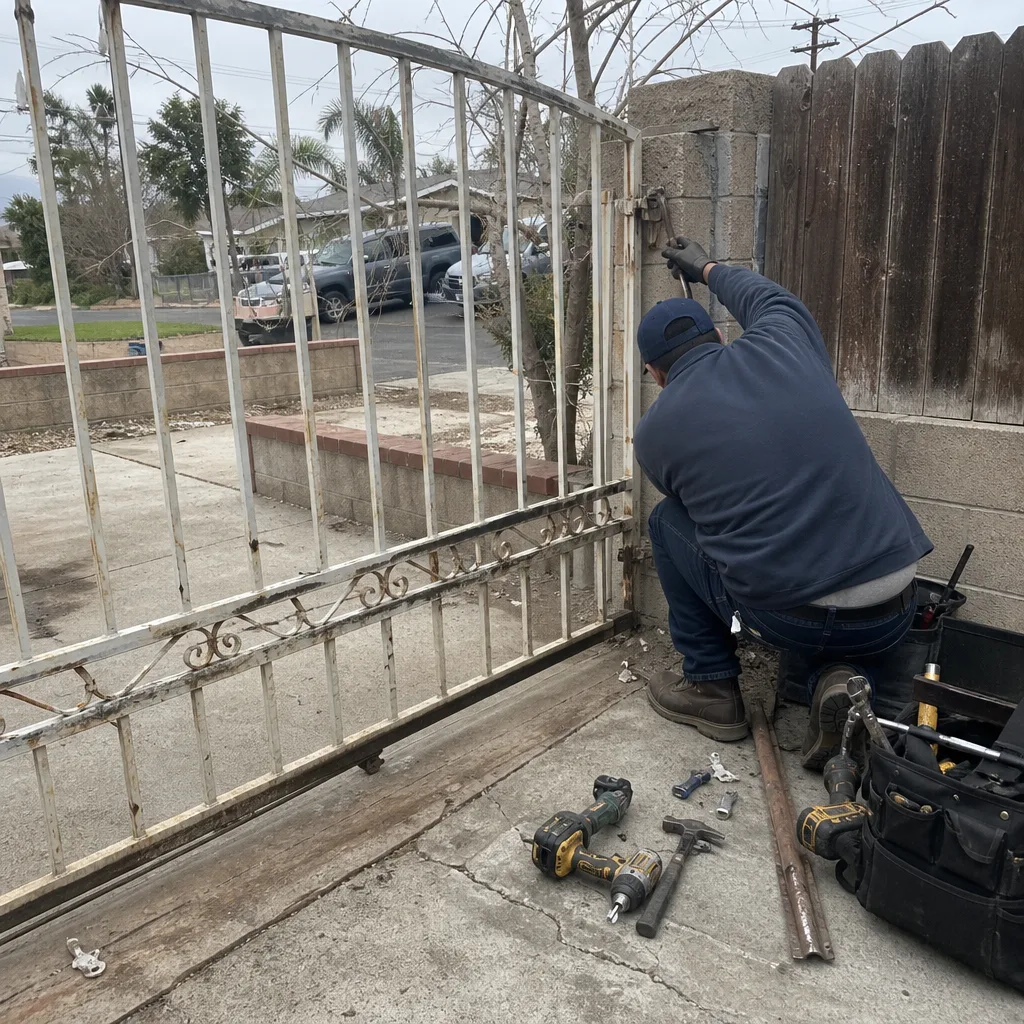 Before
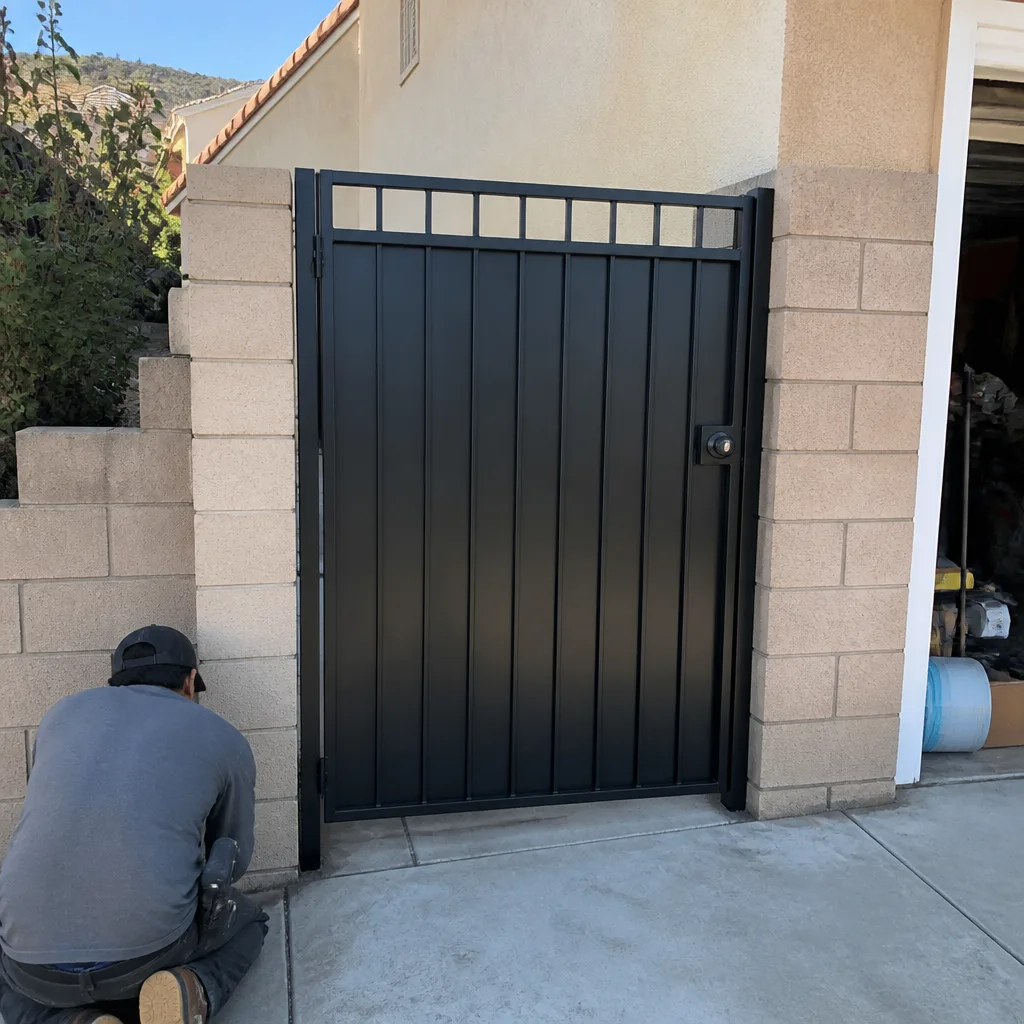 After
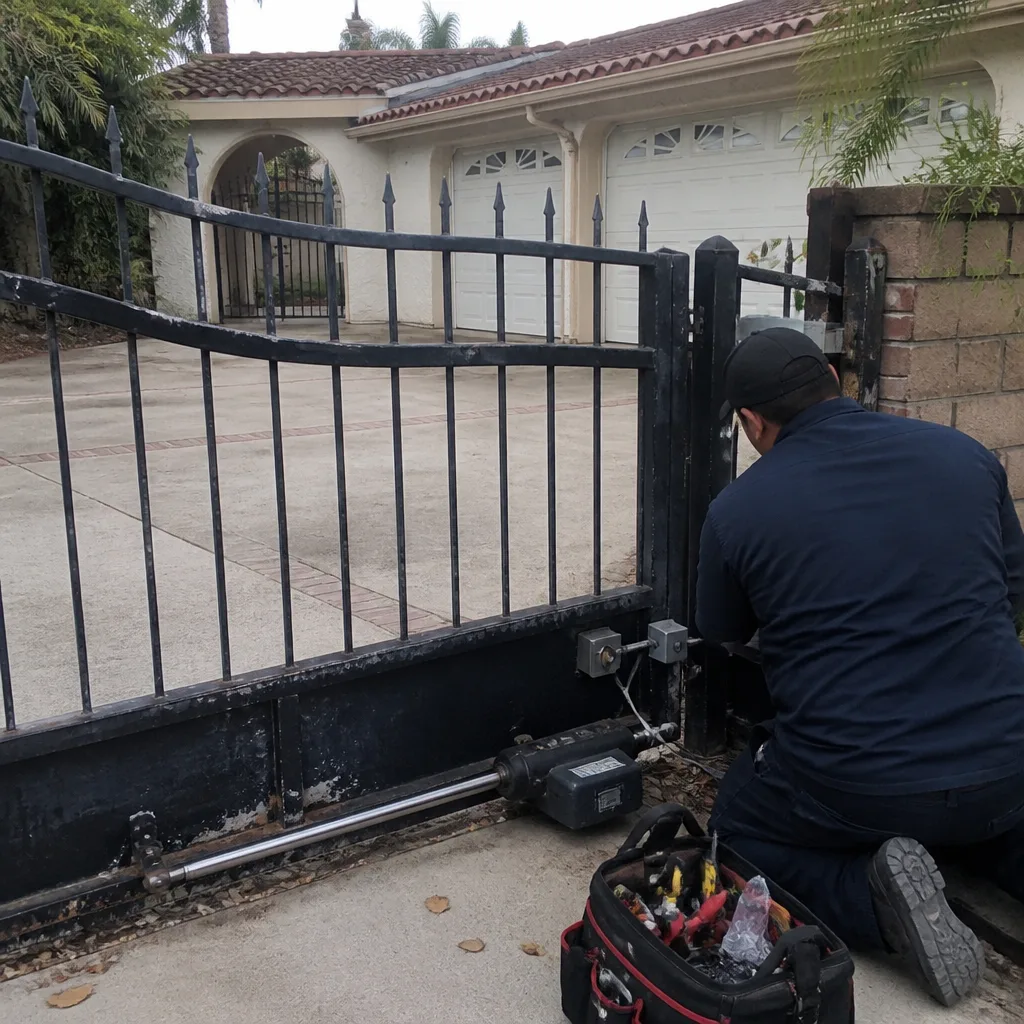 Before
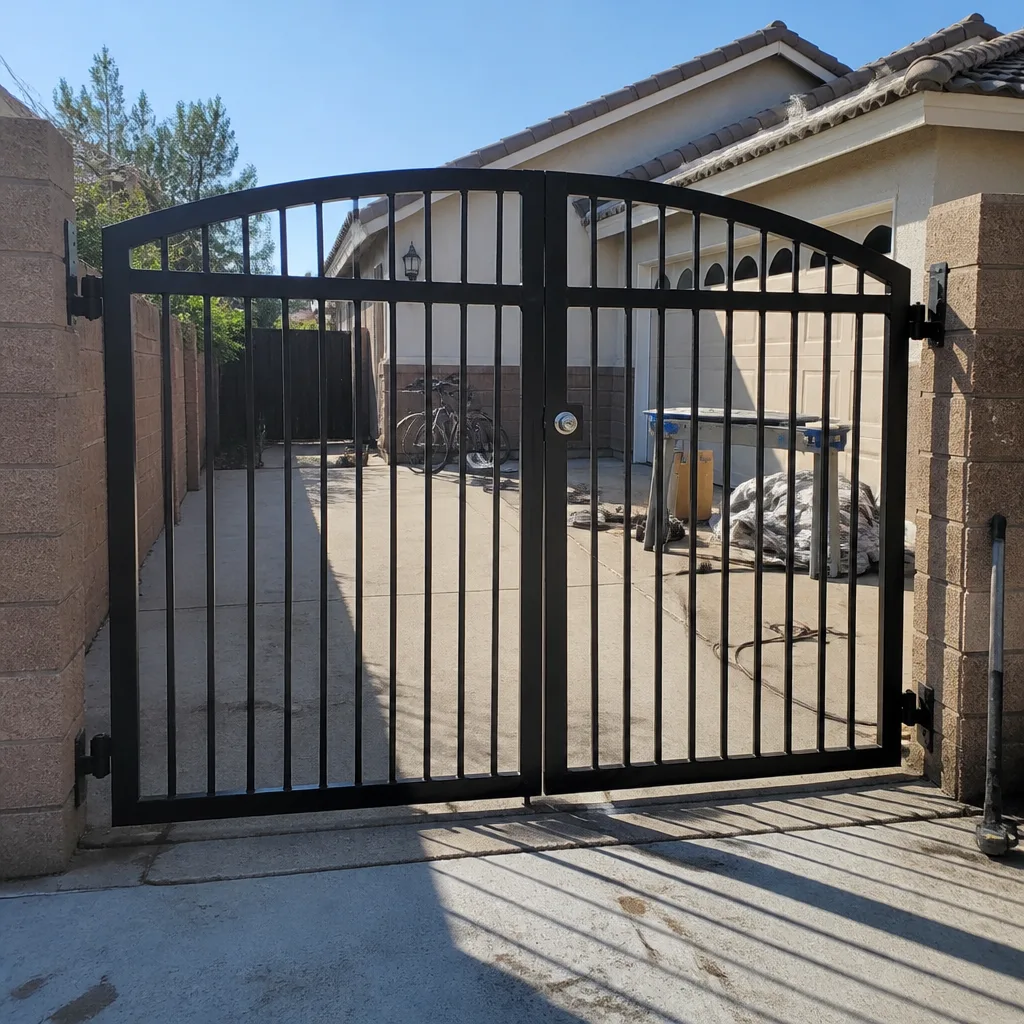 After
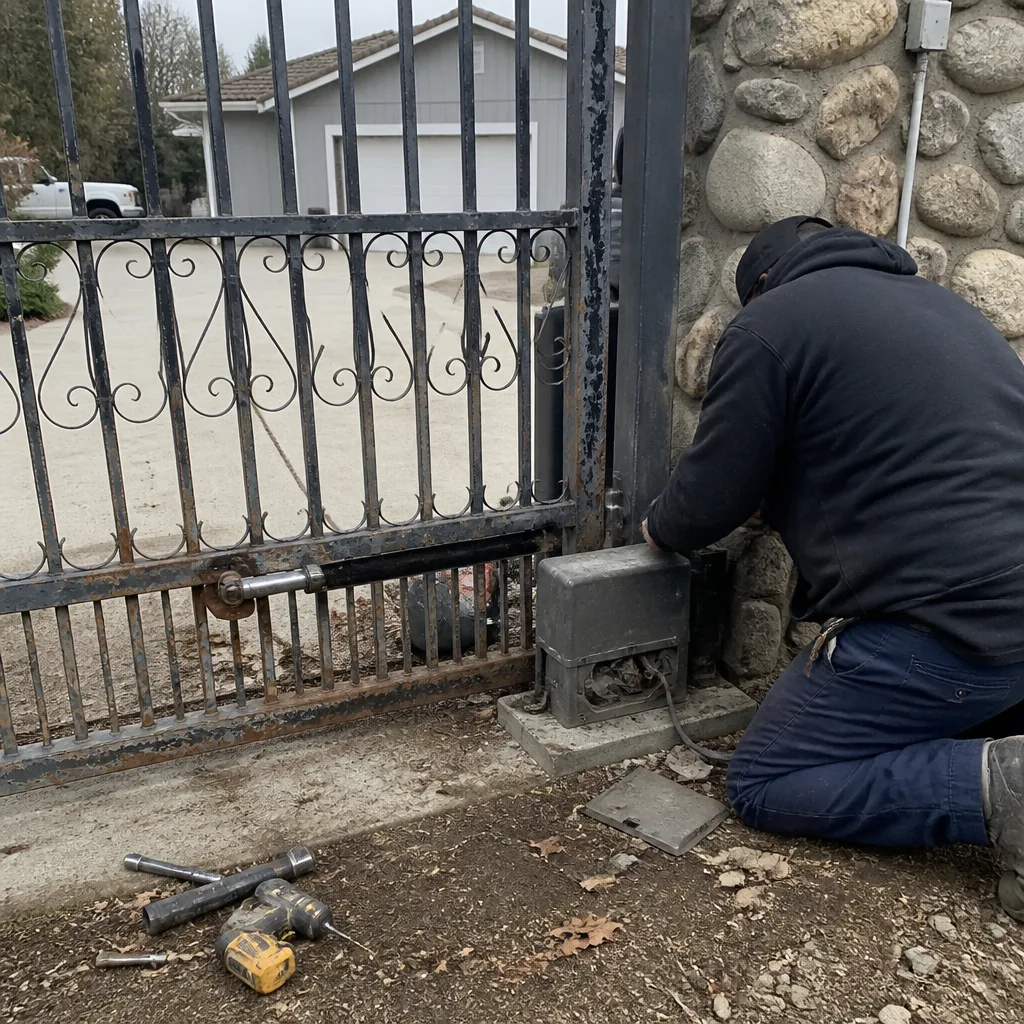 Before
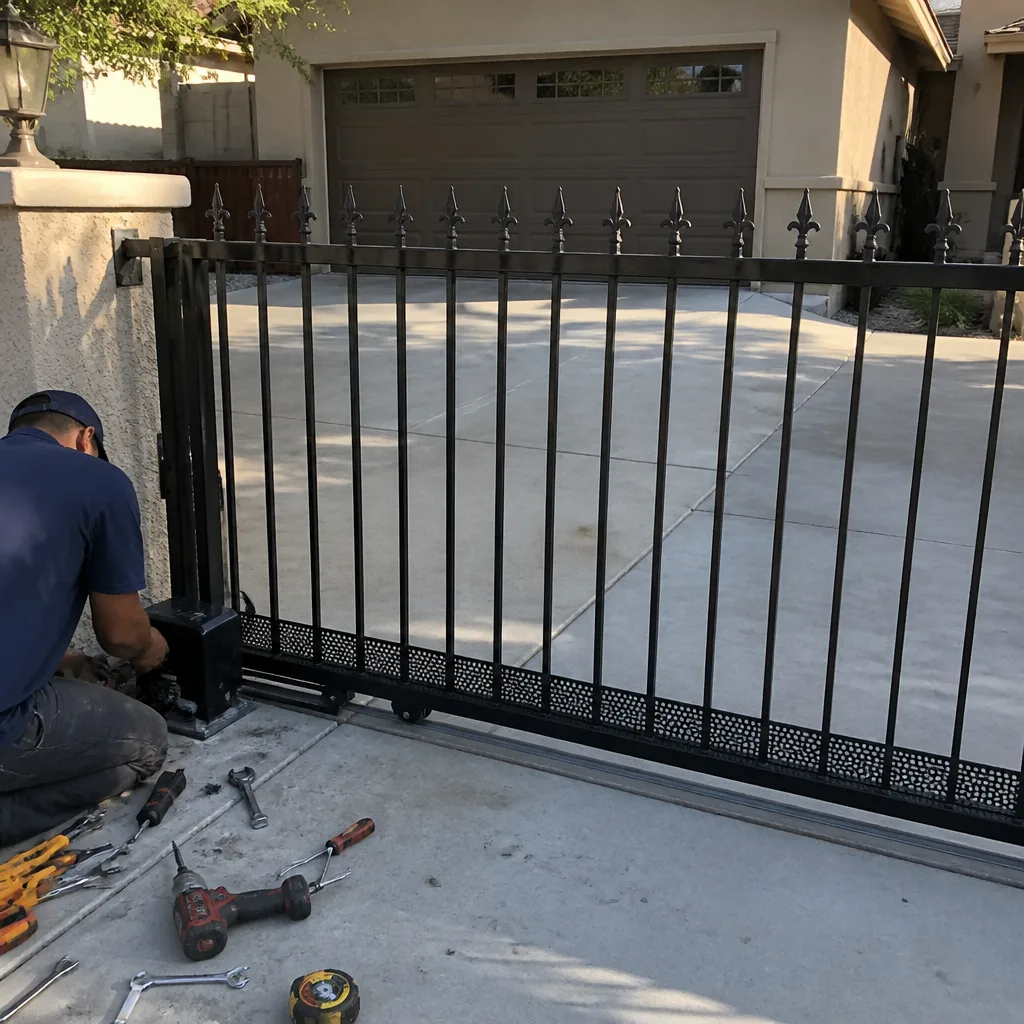 After
When to Call a Professional
Gate repair is not a DIY project. The operators run on line voltage, the springs and counterweights are under significant tension, and misaligning a safety sensor can result in a gate that closes on a vehicle or a person. If you’re noticing slow operation, grinding noises from the motor, a gate that reverses before fully closing, or a keypad that works intermittently, those are all signs that a component is failing, and the repair is a job for someone who has done it before. Don’t open the control box to “take a look.” The control board carries live current even when the operator is idle, and the capacitor in the operator can hold a charge after power is disconnected. Baron Gate Repair offers free estimates in Corona, call (877) 752-1896 to get a gate specialist on site.
Frequently Asked Questions
Gate repair in Corona typically ranges from $150 for a minor sensor alignment or hinge adjustment to $800 plus for a control board replacement on a premium European operator. The exact cost depends on the brand of your operator, the specific component that failed, and the labor involved. The only way to get an accurate number is an on-site diagnosis. Call (877) 752-1896 for a free estimate, and the price will be quoted and agreed before any work begins.
Ask the contractor which gate operator brands they service and whether they stock gate-specific parts. A gate specialist answers with brand names immediately, while a garage door company talks about garage door openers and “we can take a look at gates too.” You can also ask the interview questions in this guide, the limit switch versus torque overload question is the fastest sort. If the contractor can’t answer it, they’re not a gate specialist.
A legitimate gate repair quote includes a written diagnostic description of the problem, the specific part or parts being replaced with brand and part number if applicable, labor as a separate line item, any travel or service call fee explicitly stated, and a total price agreed before work begins. If any of these elements are missing or vague, ask for clarification in writing before authorizing the repair.
Yes, a gate specialist can service Mighty Mule openers, and they should be willing to do so without pushing you toward an expensive upgrade. Mighty Mule systems are designed for DIY installation, which means they have known failure points that a specialist recognizes quickly. We service Mighty Mule gates regularly in Corona, from single-swing driveway gates to double-swing ranch gates, without requiring customers to replace a system that still has service life left.
Most gate repairs are completed in a single visit, and the actual work often takes between one and three hours depending on the component. Control board replacements, sensor alignments, hinge replacements, and force adjustments are all typically same-visit repairs. More involved work, such as replacing an underground loop detector or rebuilding a gate frame, may require a second visit or a scheduled installation slot. The contractor should be able to tell you before the visit whether your repair is a single-visit job.
If an uninsured contractor is injured while working on your property in California, you can be held personally liable for their medical expenses and lost wages. Your homeowner’s insurance may cover some of this, but the claim could also exceed your policy limits. The protection is verification: ask for a current certificate of insurance before the contractor starts work, and confirm the policy covers the type of work being done on your gate.
The Bottom Line
Hiring a gate repair contractor in Corona is a filtering process. Filter out the garage door companies and handymen by asking brand-specific diagnostic questions. Filter out the unlicensed or uninsured operators by verifying credentials before you schedule. Filter out the vague quotes by demanding a written diagnosis and a firm price before work starts. What remains is a contractor who can identify the problem on your specific gate, quote you honestly, and fix it correctly the first time. That’s the standard the gate repair industry in Corona should meet, and it’s the standard you should hold any contractor to before you invite them onto your property. For more guides & resources, visit our blog.
Written by the team at Baron Gate Repair, serving Corona since 2017.